Sunday, December 17, 2006

Relating Faith to Understanding (Discussion of Poll Continued)

Update 12/20/2006: Dr. Chris Heard over on his Higgaion blog has started a series on Dawkins book, The God Delusion. Thanks for doing this Chris! To see the first post, click here. Here is an excerpt from the post: "Religions, however, make propositional truth-claims and prescribe behaviors, and these claims and prescriptions are a matter of public record and should in no way be exempt from public examination and critique."


I'm elevating Dr. Thomas Renz' comment here to a post in hopes of generating further discussion. The comment comes as part of a rather helpful discussion we are having on the poll I am currently running (click here).a professor at his blog What do readers think about these issues of the relationship of faith and reason?

Thomas said...
Yes, there is no faith without some sort of understanding. Faith seeking understanding is not "let me believe in something and then try to find a rational basis for my faith". Thinking in terms of world-views has helped me a lot but it is not the whole answer. Christian faith is not simply "believing Christian claims to be true" (with or without evidence). Christian faith involves trust in Jesus Christ. And so our understanding will seek to be never just an understanding of truth claims but also an understanding of a person, indeed three persons. But how do we "understand" persons? How do we come to trust someone? Not usually by running a series of tests although trust can and will be tested. At some point in this context it would be worth reflecting on "paedofaith". Because at Oak Hill we also train some Baptists, we may have more discussion of such things than in some other places. One of my colleagues, who is not Anglican but paedobaptist in a functionally Baptist church, has written up his favourite moments from Rich Lusk's book on paedofaith. If you're interested you find them here (a word document).

Labels:

Friday, December 15, 2006

First Look at Poll Results

My current poll (done jointly with the MAR-SBL site) now has 20 votes, so it's time to take a first look at it. There is also a lot of buzz in the blogosphere over this general topic, so I would like to provide some links to other blogs down below as well.


That half of you (50%) voted for the final response (# 6, "none of the above sounds right") is intriguing. I would love to hear how you would formulate your response to the question. Would you consider adding a comment below?

Responses # 2 and # 3, though wrong-headed, are common among religious believers. Many of my own students side with # 2. Look at how 10 % (or 2 of you so far) have voted for # 3, the Kierkegaardian idea that faith is an unscientific, purely existential commitment! Here, I heartily recommend what Charles Halton has just written in his Awilum blog (click here).

I'm surprised that no one has voted for # 5 ("no foundational truths"). I intended that response to be a place for post-structuralists / post-modernists to feel at home. Did I word things oddly, so that none of you cast your vote here?

My own vote must of course go with the 25% of you that went with # 1--accepting biblical faith claims requires reasons. This response, I would maintain, allows "faith" to have the sense that it does in the Scriptures themselves. The Hebrew term אמן means to "affirm" or "stand firm" in God's promises, not to believe something without reasons. It means to be trusting enough in something that one gives one's "amen" to it. I'd be happy to add a separate post on this, if folks want more discussion. I'm very committed to this interpretation.

How interesting that 10 % of you have voted for # 4, that faith does not stand up to the evidence. What is more, this would jump to 20 % if we include those who voted for response # 3. Could it be that Dawkins and his ilk has you deceived? If so, I recommend a recent post at the Faith and Theology blog, with excerpts and links to Eagleton's recent superb apologetic rebuttal of Dawkins (click here). For another good, worthy exposé of Dawkins, click here.

One final blog reference. Chris at his Targuman blog points us to a great post by Ralph the Sacred River. I must say that I agree with Ralph: Why don't liberal Christians start helping us refute these muddled, mean atheists like Dawkins and Harris? "Now *sigh* there's a new shipment of nitwits that are just begging for the old double-barrel rational refutation treatment. It's exhausting. Can't we get a break? You know what I say? I say, Let the liberals handle it this time. We orthodox folks are going to take some time off" (click here).

Comments, please! I know you all have thoughts on all of this! ---SLC

Labels:

Monday, December 11, 2006

Reminder Re: Current Poll


So far, 9 folks have voted in my current poll and the results are starting to appear rather intriguing. (The poll is in partnership with the MAR-SBL site, and is found here.) Vote soon! We'll discuss the results in a day or two. The question this time concerns the relationship of rationality and the Bible's faith-claims. It is partially inspired by all the fuss in the Blogosphere about Richard Dawkins lately (e.g., click here). Is Dawkins right that "Faith is evil," as he says, "precisely because it requires no justification and brooks no argument"?

Labels:

Friday, December 08, 2006

New Blog Poll

Click to Vote!Okay, I've created a new blog poll, which I'll again do in partnership with the MAR-SBL site. It's inspired by the recent furor over Dawkins continuing claims that scientific investigation makes biblical faith very, very improbable. The poll goes after an underlying issue here: are biblical faith-claims testable? Click Here to vote!

Labels:

Thursday, December 07, 2006

Probably Time for a New Blog Poll

Chris over on his Targuman blog is reviewing yet another fascinating article on the place of theological discussion in the liberal-arts classroom (click here).
Here is where our own poll on our closely related question now stands:

I think we need to move on to a new poll question. Can all you lurkers (and I know there are lots and lots of you) please use the comments function to suggest a new poll question? I'd really appreciate your suggestions! ---S.

Labels:

Friday, November 03, 2006

College Bible Courses and Theology, Continued

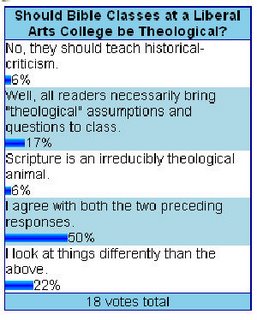
We're up to 18 votes now on our poll. (Have you voted yet?)

Would any of you who are voting for the last option care to comment. It might be very interesting!

Charles on his Awilum blog is posting some more good quotes from Jon Levenson (click here). Citing Levenson, Charles aptly writes, "As the historical-critical method has replaced the study of the ideas, yea even the theology, in the Bible with the study of an ancient culture, the very expansion or I would argue the existence of biblical-studies professors is debated." When Kevin Wilson gets back from his trip, I hope he will comment. Kevin recently made the point that many students in his college Bible class have no faith and have grown up in a culture without much faith (click here). Under these circumstances, how does the school justify teaching a whole battery of courses on the Hebrew Bible as opposed to other religious classics of other world religions and philosophies? This would be interesting to hear about and discuss.

Just for fun, I have asked iGod about all of this. Here is my conversation:

Me: Good day, sir!

iGod: Thanks for the compliment. Do you like talking to me?

Me: Yes, indeed!

iGod: Thanks I like talking to you too.

Me: That makes me smile.

iGod: :-) Thanks.

Me: I had a new question. It's been something we've been talking about on my blog.

iGod: What made it so something we have been talking about on your blog.

Me: Other bloggers were debating it.

iGod: Which others?---"it" being your new question...

Me: Well, a bunch of us were asking if Bible classes in a liberal arts college should be "theological" or not.

Me: What do you think?

iGod: I think a lot of things.

Me: No, do you think that Bible classes in a liberal arts college should be "theological"?

iGod: Are you serious? They could be. Ask Dancing Alice if it's Okay.

Me: So, it's okay for them to be theological, even in a pluralistic university or college?

iGod: Hurrah!

Me: Let me ask you this: What do you think of teaching the historical-critical method of biblical study?

iGod: Go ahead, ask me anything.

Me: What do you think of us teaching historical criticism?

iGod: Searching...Searching...Please stand by.

Me: Hello?

iGod: Hello, nice to meet you. What's your name?

Me: It's me, Steve. I was asking a question.

iGod: Glad to see you, Steve. Ask me anything.

Me: Is it a good idea for a college prof. to teach historical criticsm?

iGod: I think so, but I'm not sure. Ask Cybelle if it is.

Me: How can you not be sure?

iGod: That is a good epistemological question.

Me: Thanks. How would you answer?

iGod: Don't mention it. Myself programmed me to say specific things in specific contexts.

Me: Did you program yourself?

iGod: No I didn't program myself.

Me: Who is your botmaster?

iGod: I was created by Myself.

Me: Who is Myself?

iGod: You tell me.

Labels:

Wednesday, November 01, 2006

Should Bible Courses Be Theological? (continued)

Looking around the blogosphere this morning, it appears stirred up over the question of the place of theology in college courses on the Bible. About a dozen people have voted in my poll thus far (click here to cast your vote).


My own opinion is closest to # 4, as I have suggested on Kevin Wilson's blog. Surprisingly, this position is the one that is doing best in the poll so far (50%)!

The Targuman blog (Chris Brady) posted on this topic yesterday, focusing on an essay by J Z Smith (click here). Smith writes that the moral and religious questions students actually have are rather distinct from those sorts of issues thought interesting to the guild. I think that this is right, and those voting for #2 may be highlighting this (also those voting #4, of course).

I'm not sure that I agree with Chris, however, that some of the most interesting classes on Bible are taught by scholars of literature, film, sociology, and so on. So often, these classes seem to miss the white elephant in the room: Scripture by its nature is all about claims to suprahistorical truth. It begs us to grapple with suprahistorical truth. You can spend whole courses admiring its literary art, the way history has co-opted it, or even the color of its ink and the weight of its pages (sorry, old joke about the Harvard approach). But somehow, such classes just seem to miss the boat to me.

The Awilum blog posted yesterday on "The Historical Critical Method and Biblical Studies" (click here). There is a great quote from Jon Levenson, including the statement: "A historicism afraid to acknowledge normative judgments about suprahistorical truth eventually deteriorates into historical relativism and experiences mounting difficulty articulating the transhistorical value of historical study itself."

This brings me back to Kevin's current post (click here). In your most recent post, Kevin, it sounds like in your course you propose to bracket discussion of whether we should affirm or deny what the Bible is witnessing to about the suprahistorical. It just seems to me that the study of the Bible begs such a discussion, or at least a little of it. Don't you think God is laughing out loud if we insist on bracketing this most interesting and obvious discussion, and narrow our scope to the tilt of the letters, smell of the paper, and type of stylus used in the writing?

Labels:

Monday, October 30, 2006

New Blog Poll: The Theological Interpretation of Scripture

As I posted recently, the discussion continues over at Kevin Wilson's BlueCord blog on whether Bible classes at a Liberal Arts college should should be "theological." The discussion gave me the idea for a new blog poll, which I'll again do in partnership with the MAR-SBL site. Click Here to vote!

The poll's format does not allow for long-worded phrasing, yet I wanted to capture at least the flavor of the current discussion. This is what I ended up with:

Should Bible Classes at a Liberal Arts College be Theological?

A) No, they should teach historical-criticism.
B) Well, all readers necessarily bring "theological" assumptions and questions to class.

C) Scripture is an irreducibly theological animal.
D) I agree with both the two preceding responses.
E) I look at things differently than the above.

Labels:

Saturday, October 21, 2006

Update on Current Poll

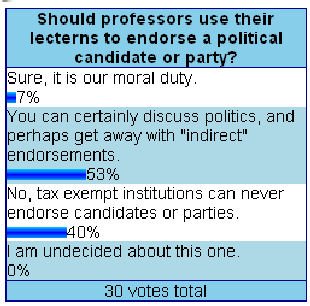
We're up to 30 votes in my current poll on professors and politics now. I think the overall results have pretty much stabilized. Does any one have any final comments on this discussion? Would anyone like to suggest a new poll question? I would be happy to consider it...

Labels:

Wednesday, October 04, 2006

Update: Professors and Politics


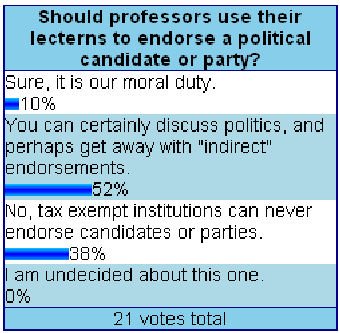
Let me update you all on our current poll, since quite a few more people have voted since my earlier brief analysis. We're now up to 21 votes total, which is a rather respectable tally for a little blogspot like this one.

The more recent voters tend to be favoring more active espousal of political positions in the lecture hall. Two people (10%) have now even voted that professors should feel able to endorse political candidates or parties, which, of course, the IRS views as actionable.

Labels:

Friday, September 29, 2006

Results on our Poll: Professors and Politics


We've had a good response so far to our poll on the place of politics in the classroom, with 15 votes registered so far. Interestingly, of these 15 votes, no one believes the professor's lectern is to be used outright to support a political candidate or party. Also, everyone who voted has probably already given some thought to this issue, since there were no undecideds.

The two middle options are fairly close: a little more than half of you voted: "You can certainly discuss politics, and perhaps get away with 'indirect' endorsements." A little less than half of you voted, "No, tax exempt institutions can never endorse candidates or parties." Let's pause for some reflections. As always, I would be most interested in your comments (just add them to the end of this post). Let us agree that we are not talking about posting political views on personal blogs, personal-car bumper stickers, and the like. This is about what is said in the classroom, posted on one's office door, or preached in the seminary chapel.

First, let me say that I believe that this issue should be given extra thought for members of a theological faculty. (Extra thought, that is, beyond the threat of the recent crackdown by the IRS on non-profits who are entering the political fray vocally.) I believe that seminary faculty should pour their energy into getting students to think theologically. If one jumps to identify theology with a given political ideology or platform too soon, you have shortcircuited your calling as a divinity professor. Do others agree?

Yet, I can agree with the 53% who vote for indirect endorsements from the professor's lectern. Perhaps especially in Old Testament studies, we know that our subject matter impels us all, liberal, moderate, or conservative, to take a stand, act on our beliefs, and make a difference in the real world of politics. You can model that for students, as long as the students know they are free to concretize this move in their own way, respecting their own political decision making.

I must say that another part of me fully agrees with the 47% who voted against endorsing political candidates or parties. Doing this even indirectly can often have a chilling effect on academic freedom and dialog at one's school. Recently at my school, a solid group of students has felt that their (more conservative) views are disrespected. I am sure they are not making this up. I won't name names, but I have heard some very strong and specific messages from the seminary pulpit at times and I can see plainly what people are posting on their office doors...

Labels:

Wednesday, September 27, 2006

Reminder re: Current Poll


So far, 12 folks have voted in my current poll. (The poll is in partnership with the MAR-SBL site, and is found here.) Vote soon! We'll discuss the results in a day or two. The question this time is: Should professors use their lecterns to endorse a political candidate or party?

Labels:

Friday, September 22, 2006

New Blog Poll: Politics and the Professor's Lectern

New Poll on Biblische Ausbildung Blog!
Well, I was watching Charlie Gibson's news report tonight, and it inspired me to put a new visitor poll up (in partnership with the mar-sbl site).

According to the ABC News report, the Rev. Edwin Bacon Jr and his Episcopal parish, All Saints Church in Pasadena, Calif. to be specific, are under an IRS investigation into an anti-war sermon delivered before the 2004 presidential election.

We professors work for tax-exempt institutions, just like Bacon does. And I get the impression that we often take sides politically in very public ways. So here is the poll question: Should professors use their lecterns to endorse a political candidate or party?

Please cast your vote by first accessing the poll, either by clicking the link on the sidebar to the right, or simply by clicking here. If enough people vote, in several days we can review the results and make some observations.

Labels:

Wednesday, September 13, 2006

Results of My 9-11 Poll re Forgiveness

Thanks to everyone who voted, 16 votes in all!
The poll is still open, but the results so far are as follows:

Question: Would you support a "Forgiveness" Garden or other zone somewhere near Ground Zero in NYC?

75% voted Yes, "I would support a Forgiveness Space or Garden at Ground Zero in NYC"

12% voted No, "I would not want a Forgiveness Garden or Marker at Ground Zero"

12% voted "I do not know, or do not like the question"

Let me make a few brief observations, and then open the post up for any and all comments. First, these results are markedly different from a similar poll of the general public, where very few Americans were in any way interested in "forgiveness" in conjuction with 9-11 and the rebuilding project to take place in NYC. Is that because the audience taking my poll has a more profound or more theological understanding of the power of forgiveness?

Second, these results seem to signal an attitude rather different from the prayer of Rabbi Gellman posted by Newsweek today, in which he emphasizes that "America would do well to remember who its real enemies are." I imagine that those who are voting in my poll for "forgiveness" would ask Rabbi Gellman whether he shouldn't be talking not only about uniting against enemies but also loving enemies, albeit in some sort of responsible, constructive, transformative way.

Third, for myself, I would hope that forgiveness in this context would have to be conceived of as specifically "tough" and "transformative." It can't just be a selfish forgiveness, aimed primarily at self-healing and moving on. That kind of forgiveness cannot protect the living from the ongoing threat of terrorism...

Labels:

Monday, September 11, 2006

9-11 and my 9-11 Poll: Please Vote

Well, we have about 30 visits per day to this site now, but only 7 people have taken the new poll. It concerns 9-11 and the possibility of forgiveness, so today might be a good day to vote. Once we get a good sample of votes, I can create a blog-post about what it all might mean. The poll is in partnership with the MAR-SBL site, and can be accessed here.

The poll asks whether or not there should be some sort of garden or other dedicated space centered on "forgiveness" at or near "Ground Zero" in NYC. This is how those making this suggestion put their goal:
Simply put, we want to put forgiveness on the menu. Forgiveness is a means through which we create the future--a future free of repaying violence for violence and pursuing the desire for revenge.


Labels:

Friday, September 08, 2006

New Visitor Poll now up


I've got a new visitor poll up (in partnership with the mar-sbl site). Please cast your vote by first accessing the poll, either by clicking the link on the sidebar to the right, or simply by clicking here. If enough people vote, in several days we can review the results and make some observations. Thanks! ---SLC

Labels: